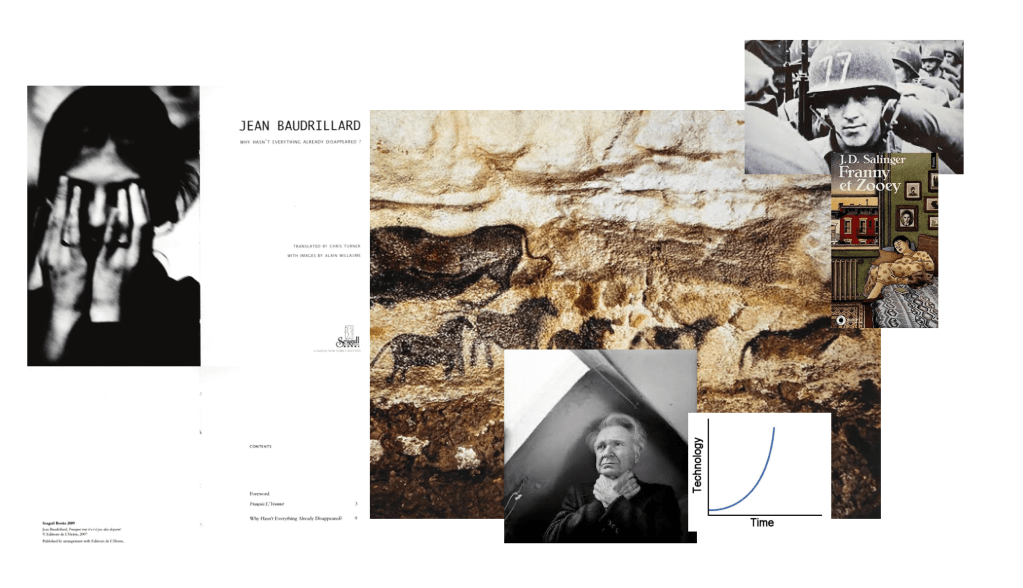
“For this really is the last straw, this aspiration to clear the way, with the digital, for the integral image, free from any real-world constraints. And we would not be forcing the analogy if we extended this same revolution to human beings in general, free now, thanks to this digital intelligence, to operate within an integral individuality, free from all history and subjective constraints.
At the end-point of this rise of the machine, in which all human intelligence is encapsulated- a machine which is now assured of total autonomy as a result- it is clear that mankind exists only at the cost of its own death. It becomes immortal only by paying the price of its technological disappearance, of its inscription in the digital order (the mental diaspora of the networks)” – Jean Baudrillard, Why Hasn’t Everything Already Disappeared?
As you may all know art is impossible to define, just like love or friendship, because the moment we attempt to explain it clearly something essential disappears and we are left only with language trying to capture something that was never meant to be captured.
Emil Cioran suggested that the decline of civilisation begins when a culture loses the inner necessity that once justified its existence, when expression continues but the vital impulse behind it slowly fades. I think we’re at this point in human history: we all loosing the impulse.
Culture surrounds us and shapes us and moves through generations yet it refuses to behave like a system or a discipline or a structure that can be organised and controlled. The moment someone claims to fully understand culture what they usually mean is ideology, and ideology has very little to do with the living pulse of culture. Culture is not a doctrine, not a strategy, not a coordinated effort designed by institutions or markets, culture is something deeper and far more chaotic, it is the subconscious of humanity slowly revealing itself through symbols, images and stories that appear again and again across centuries even when people do not fully understand why they create them.
Long before the internet existed humanity had already built its first network of meaning and memory, and cave paintings were one of the first entries into that network, because a handprint on stone or the drawing of an animal in charcoal was not simply an image but a signal sent across time by someone who needed to leave evidence that they existed, that they saw the world, that they felt fear, hunger etc, and the need to communicate with someone. That gesture was culture in its rawest form, not entertainment, not content, not messaging, but a human signal entering the collective memory of the species, a mark placed into the unknown future with no guarantee that anyone would ever see it.
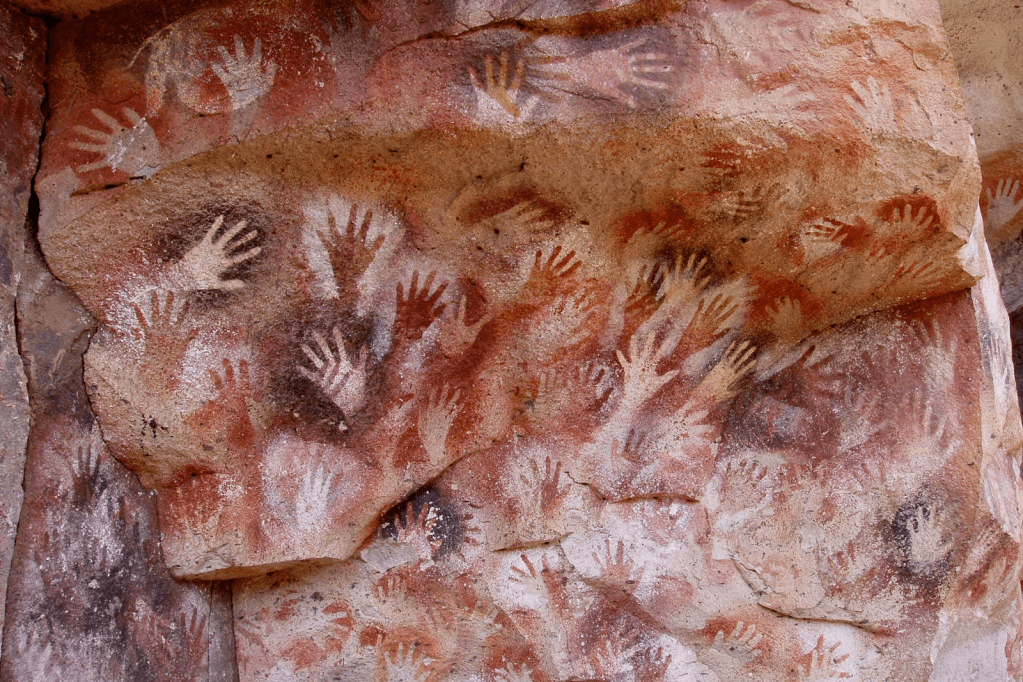
The cave painter pressing pigment into stone was not so different from the modern engineer prompting an image generator. The gesture is ancient, the tool merely changes. As Cioran wrote:
“Everything that has been done will be done again”
History does not advance – it repeats its illusions with new machinery.
In that sense culture has always functioned like a primitive human internet, a vast invisible archive where emotions, memories, myths, fears and dreams accumulate slowly across generations, where every painting, every story and every object becomes another signal inside a quiet and expanding network of human consciousness.
Something in the modern world has shifted, and the shift is impossible to ignore because culture today exists inside systems that constantly attempt to shape it, influence it and redirect it. Institutions push narratives, markets push trends, ideological frameworks try to impose interpretation, and public discourse fractures experience into endless commentary and reaction.
This anxiety also appears in literature in a more intimate form. In Franny and Zooey a character observes that people often perform intelligence and spirituality while quietly losing contact with the inner sincerity that once gave those pursuits meaning, a quiet critique of a culture that continues speaking but no longer listens to the deeper voice inside itself. The discomfort described in that novel feels strangely contemporary because modern culture often appears flooded with expression while simultaneously starving for authenticity.
Literature and storytelling have suffered deeply in this environment because narratives that once emerged slowly from lived experience are now surrounded by noise and expectation, and instead of a voice growing from the depths of a human soul we often encounter a collage of opinions assembled from signals circulating through media, platforms and cultural discourse. Stories begin to feel hollow not because people stopped telling them but because they are increasingly constructed from fragments rather than grown from experience.
“I’m sick of not having the courage to be an absolute nobody” – J. D. Salinger, Franny and Zooey
Perhaps courage is the last remaining quality literature requires. Not talent, not intelligence, not technology, but the willingness to exist without recognition. Literature once emerged from that place – from individuals who accepted obscurity and wrote anyway. Today the opposite force dominates: platforms constantly urge everyone to become somebody, to perform, to accumulate visibility. In such an environment courage disappears. And with it disappears literature.
Artificial intelligence introduces another layer to this transformation because culture can now be generated through recombination, patterns from the past can be reorganised instantly, images appear in seconds, text appears in seconds, ideas appear in seconds, and what once required time, doubt, struggle and imagination can suddenly be produced through prompts and probability.
Recombination however is not the same as creation, because creation emerges from friction between memory, fear, desire, contradiction and imagination, and that friction belongs to human experience rather than to systems that rearrange existing patterns.
Beauty still resists all attempts to fully capture or engineer it, because beauty continues to exist in that strange territory where analysis fails and recognition appears suddenly without warning. We can describe colour, form, rhythm and composition, but the real experience of beauty occurs when something external touches an internal truth that we did not know how to articulate, and in that moment we recognise something ancient inside ourselves that existed long before language.
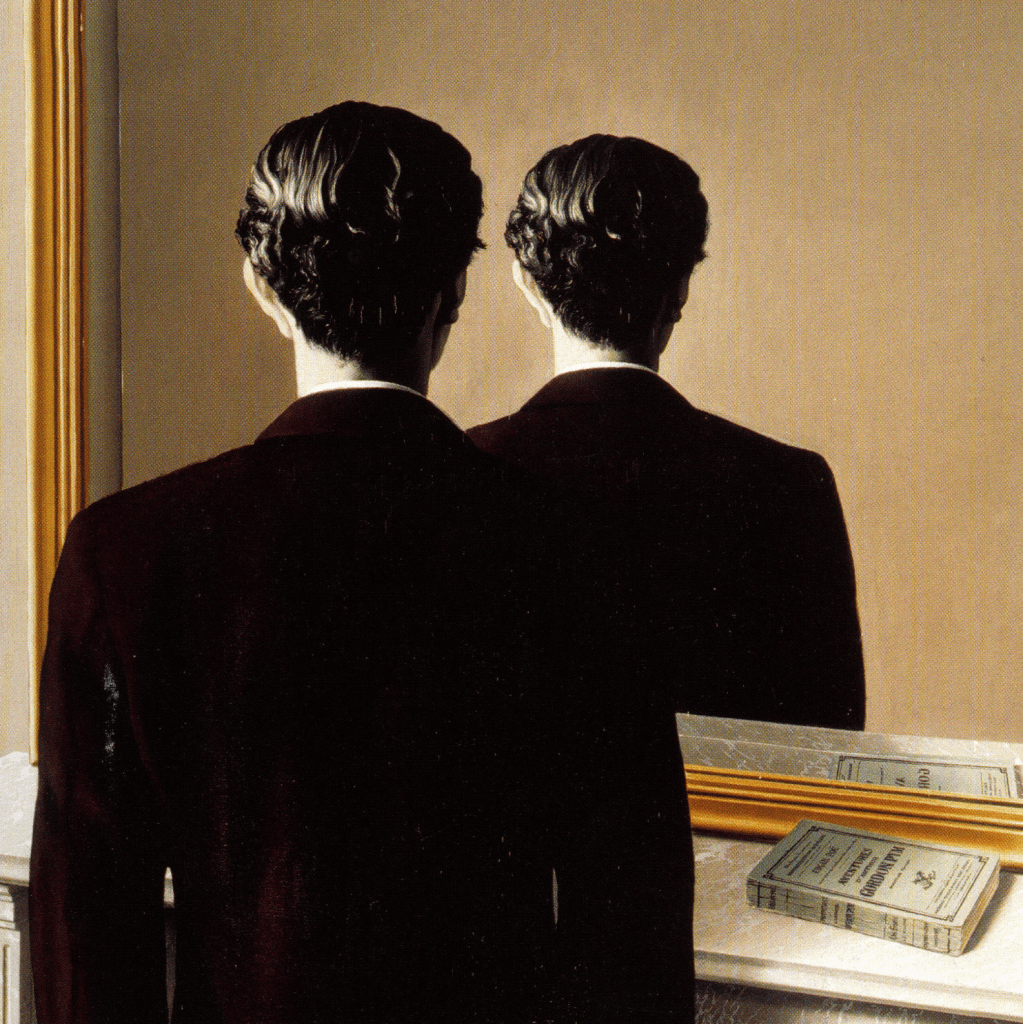
One of the images that provokes my mind more than anything in the technological landscape is a painting by René Magritte where a man stands in front of a mirror and yet the mirror refuses to reveal his face. The book on the mantelpiece reflects correctly but the man is reflected from behind again, as if the mirror itself rejects the logic of physical reality. This small fracture between expectation and perception creates a deeper experience than any technically perfect image because the painting does not imitate the world but quietly breaks it. Many surrealists explored similar distortions of reality, from Escher’s impossible architectures to Dalí’s melting clocks and the silent metaphysical cities of Giorgio de Chirico, all revealing that the power of art often appears when reality begins to behave like a hallucination.
That encounter cannot be automated and cannot be optimised because it happens in the unpredictable contact between human perception and the unknown, a place where intuition and memory quietly interact with the world.
Painting remains one of the few ways to enter that territory without mediation, because painting allows the impossible image, the one that does not exist in reality and could never be captured by a lens. Photography captures fragments of the visible world, but painting allows something that emerges from the subconscious, something that appears slowly through gesture, colour and form until an image exists that did not exist before.
The surrealist Man Ray once expressed this idea in a simple sentence when he said that he photographs the things he cannot paint and paints the things he cannot photograph, and inside that observation there is a recognition that artistic creation often begins where reality ends. Painting becomes a form of excavation, a slow digging through layers of memory, imagination and intuition where strange or unsettling forms sometimes appear, forms that even the artist may not fully understand yet that carry a certain internal necessity.
Singularity promises acceleration and control, but culture has never moved in straight lines and never obeyed a single centre of intelligence. The problem is that civilisations do not disappear because machines become intelligent. They disappear when human imagination becomes obedient.
Singularity is fake, like most of the modern ideas.
To be continued in Part II…
