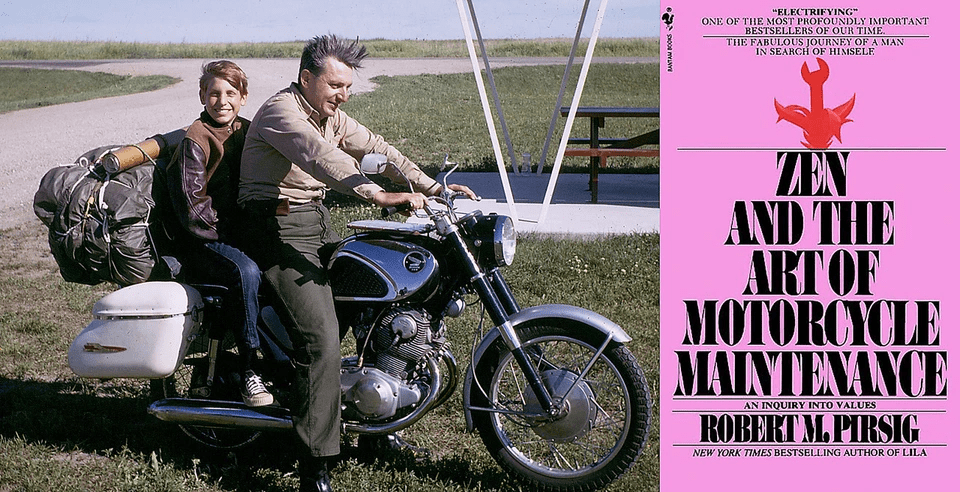
Like most readers, I have mixed feelings about this book. First of all, I immediately recognized the image of a father, which I absolutely cannot stand. There is an unbearable indifference, an inability to empathize with the child (or even attempt to think like him), and a complete lack of minimal interest. What could be more important for a young mind than to feel equal with an adult, not to feel that pressure, but to be somewhat of a friend? A silent and thoughtful father who doesn’t even kill himself at the end of the book — how many such dreary images inhabit literature…
“Dad?”
“What?”
“A little bird takes off from the tree in front of us.”
“What should I be when I grow up?”
The bird disappears behind a distant ridge. I don’t know what to answer.
“Be decent,” I finally say.
“I mean, what job should I have?”
“Any job.”
“Why do you get angry when I ask about this?”
“I’m not angry… just thinking… well, I don’t know… I’m too tired to think right now… It doesn’t matter what job you have. It doesn’t matter.”
Good lord, how angry I was when I read this “doesn’t matter”! People read all sorts of stuff by D.T. Suzuki and Lao Tzu, then walk around saying “it doesn’t matter what book,” “it doesn’t matter what job,” “everything is empty, the main thing is order within yourself, look, this is order and this doesn’t matter, doesn’t matter, doesn’t matter.”
But, of course, the book is mostly not about that, nor is it mainly about fathers and children. Undoubtedly, there is some marketing trick here, as for 9 out of 10 people, the title implies something “relaxing” (at least authors writing such travel books imply tranquility, and here there’s also the word “Zen” – generally, I even heard a similar phrase from my friend before reading: “Oh, you’re going on a trip, then take Pirsig’s book with you”).
The book, of course, has nothing to do with relaxation in travel, don’t be misled by the word Zen or advice from friends who haven’t finished the book (I initially didn’t finish it either). During the journey, it irritates and frustrates, and personally, I was outraged not only by the snobbish, contrived spells-reflections on technology, Poincaré, Lobachevsky, the philosophy of quality, poetry, Plato, Chautauqua, etc., which create an impression not of liberation, but rather of enslavement, but also I was finally infuriated by the description:
“Pirsig leads a solitary and reclusive life, like writer J.D. Salinger”.
When talking about seclusion and mentioning Salinger — I lose my mind, start tearing up any books I get my hands on, and sometimes even my own writings, because what I want most is for people to stop inserting the word Salinger into every writer’s biography.
Nothing good came from the aftertaste of the book.
But still, a year later, I finished reading this book and, as usually happens in such situations, “was utterly enchanted.” The nervous journey, the uneven passage of time, the impossibility of getting to the truth, the captivating duality of the world that so charmingly irritates Pirsig himself, resulting in a kind of petrified and swollen interior from endless reflections. He gets entangled in an easily explainable unconscious indifference to his son…
Yes, in general, everything can be explained and understood, the main thing is to leave conclusions for later. I realized only after finishing that I was nitpicking at every letter simply because I expected too much from the book, some sort of epiphany or something like that, and that’s the book trap that is sometimes hard to avoid. And I — hit me, I fell for all of this — agree with Pirsig regarding his philosophy of quality, regarding the need to leave behind in childhood those dreamlike desires easily captivating a person, anticipations of a better moment, etc., and to work at any job:
– editor of technical brochures;
– auto mechanic;
– janitor or plumber… etc.
The main thing is to observe and notice with quality.
April 2014
