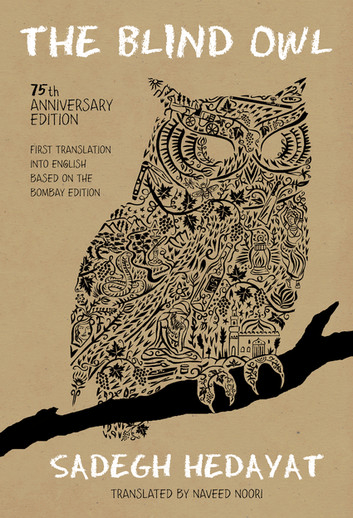
This book is considered one of the most important written in Persian. It’s easy to believe this. Look closely, and anyone who doubts will see that Kafkaesque absurdity and fear of the world are perched over every letter. Implicitly, there’s an atmosphere of Poe and Gogol—hidden beneath this book, or even this “pamphlet” (it’s very small), are all those whom we value and love.
But most of all, “The Blind Owl” reminds one of Kafka (Hedayat translated many of his works). Like the tormented Franz, Sadegh also didn’t feel it necessary to publish his writings, and he diligently consigned them to the flames—this happened with his last works, which he burned before gassing himself.
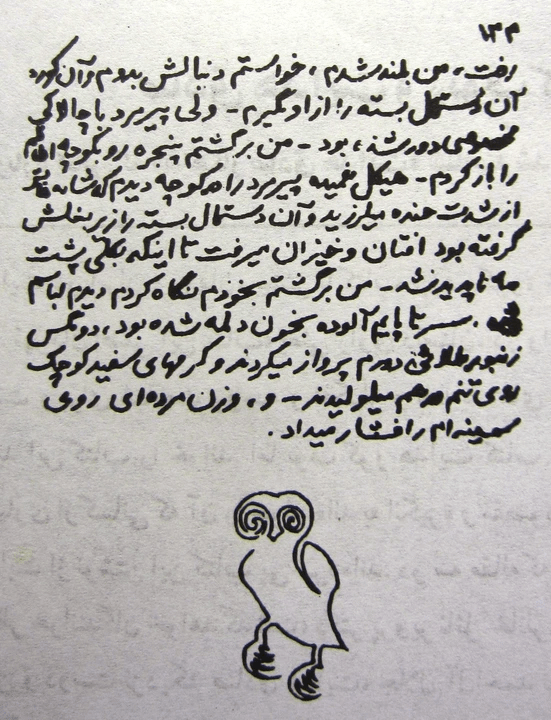
The last page of "The Bling Owl". Source
Before reading “The Blind Owl,” I familiarized myself with Sadegh’s biography, and several thousand times while reading, I imagined him sealing the windows tightly, ignoring phone calls, slowly finishing his last omelet, turning on the gas, and placing (this is an important detail) 100,000 francs beside his bed, ensuring he could be properly buried without troubling those around him too much — all of this seems sincere, considering the degree of existential expressiveness in “The Blind Owl” (especially the reflections on death).
It seems to me that this is exactly how Kafka should have ended — it would have garnered a thousand times more followers on the facebook.com.
The book itself is about the abyss between people, bottomless and unbearable, like the universe. Sadegh endowed the narrative with vivid metaphors: the “sucking mouths” of the sun drawing sweat from the body, the landscape necessarily “lifeless,” and he didn’t ignore the clouds, which he describes as “dyed with death,” crushing the entire city like a vise, which also squeezed him — his lyrical character.
The pressure and the vise, the mismatch with the world, the city, and clothing, “the world is too big for me, a child,” “the room is shrinking and crushing me” — there are many such reflections in the book, possibly encoded within other thoughts.
The book’s idea on our individual fears led me thinking on a tickling sensation in the center of my brain — fears that are hard to imagine but are always with us, stored in our wallet or somewhere under the laces of newly bought shoes, or in the spit of a random passerby.
"Fear that the feathers in my pillow will turn into daggers, that the buttons on my kaftan will become immensely large, like millstones; fear that a piece of lavash will fall from the shelf and shatter like glass; anxiety that if I fall asleep, the oil from the lamp will spill onto the floor, ignite, and burn down the entire city. Fear that the paws of the dog sitting near the butcher's shop will suddenly clatter on the ground like horse hooves. Fear that the tattered old man in front of his wares will suddenly burst into laughter and laugh so hard that he won't be able to stop; horror that the worm in the pond in our yard will suddenly turn into a cobra. Horror that my bed will suddenly become a tombstone, hinge open, and bury me, closing its marble jaws. Horror that I will suddenly lose my voice, and no matter how much I scream, no one will come to my aid..."June 2014

