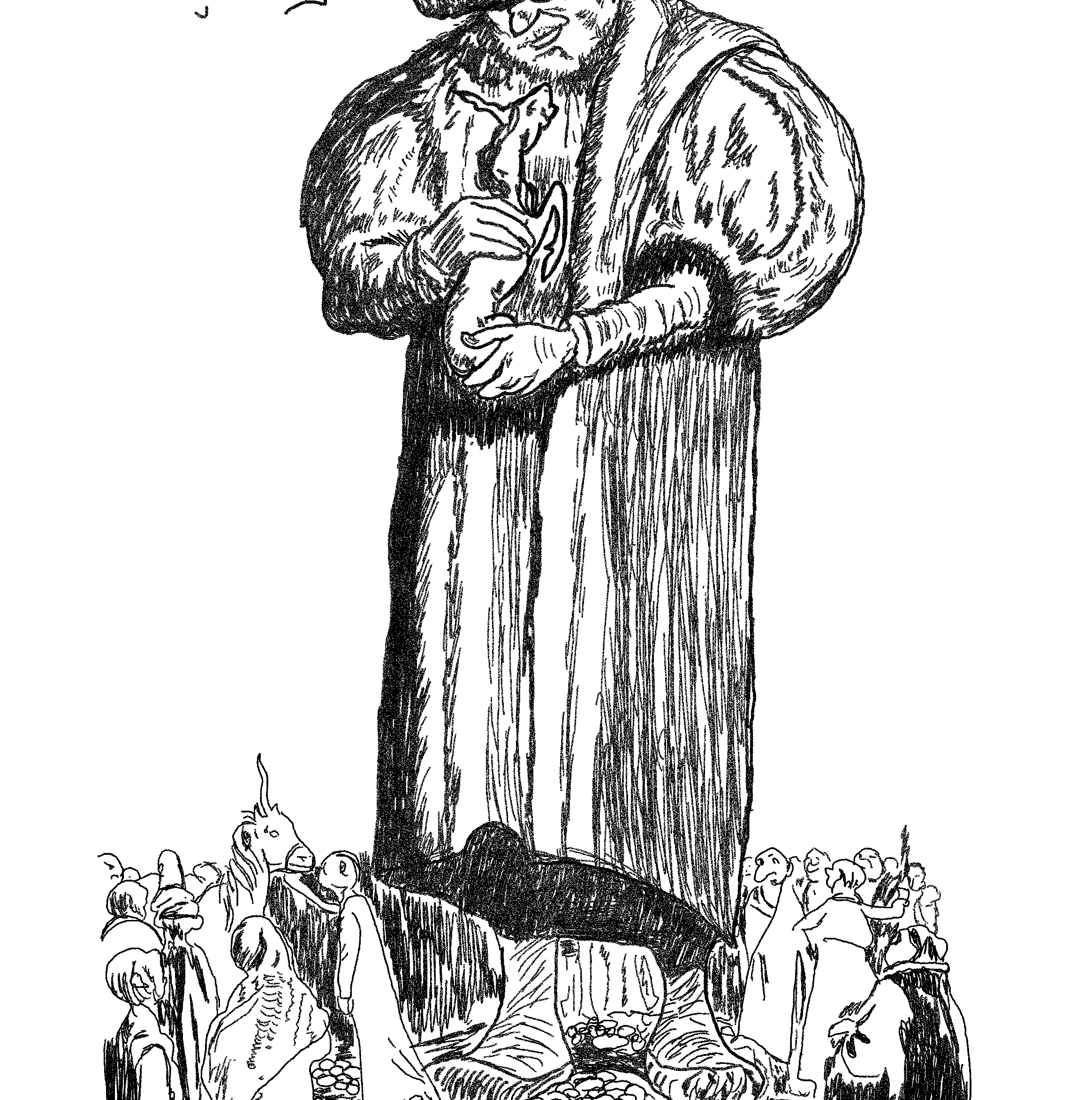
The idiosyncrasy that Rabelais’ work (written in the 16th century) provokes in our 21st century, with its “radical humor,” terrifying and “unrighteous” imagery, obscenities, and so on—precisely as if it were some kind of waste and filth that shocks and offends—testifies to the abolition of the human mind.
I came to such sad conclusions after reading an enormous number of negative comments all over the internet. If there had been fewer, I would have thought, as always, that “people are different” and left it at that. But how can one so dislike this book? The grotesque images of “Gargantua and Pantagruel” are indeed somewhat unpleasant from a realistic point of view: the act of copulation, birth (the act of being born), death (old age), excrement and urine, gluttony, violence, murder, eating living people (for example, the episode with the pilgrims swallowed by Gargantua with a salad).
But this carnivalesque, festive folk element of “ugly” images is a great alternative, a sharp contrast to the more commonly seen images of beauty, a crucial counterbalance for human thought to aesthetics devoid of such “ugliness and nastiness.” That is why, for me personally, everything in this book is important: not only these edible metaphors and the huge lists of various names and epithets (so disliked by Rabelais’ detractors), but also Pantagruel’s streams of urine, Gargantua’s fat belly, the theme of wiping.
All these marvelous images assert the unconventional in culture, acting as a kind of healing property for the world, because in Rabelais’ world everything is contrary to “common sense.” Understanding the world through the lens of seriousness has its place, but what do we do when skepticism, irony, cheerfulness, leisure, and foolishness are eclipsed by total seriousness, correctness, and dogmatism? We all understand how easy it is, in the irrationality of existence, to sign a contract with evil, to turn the whole world into a totalitarian vomit in which float the leftovers of laws, conformity, imposed rules, and norms.
This novel, with its illogicalities and absurd foolishness, provides an opportunity to feel the relativity of the world, where the wisdom of uncertainty reigns, where there is a lack of understanding of all laws, freedom of choice, lack of restraints, and so on. “Gargantua and Pantagruel” stands out so easily from the vast list of literature (in which this book will remain for centuries to come) because it has an essential perspective on the world: “This order was established by Gargantua. Their code consisted only of one rule:
DO WHAT YOU WANTMay 2014
